

Skip to content
Magazine
Sunday, December 21, 2025
SUBSCRIBE
  • About Us
  • Belgium News
    • Belgium Police News
    • Brussels News
  • EU Institutions News
    • European Commission News
    • European Parliament News
    • European Council News
  • Europe News
  • World News
  • Belgium Business News
  • Culture and Society News
  • In Depth
    • Ambassador’s Corner
    • The American Angle
    • Sustainable Perspective
    • Europe With Transparency
    • Place de la Bourse
    • The Macro-Economist
    • Southeast Europe
  • About Us
  • Belgium News
    • Belgium Police News
    • Brussels News
  • EU Institutions News
    • European Commission News
    • European Parliament News
    • European Council News
  • Europe News
  • World News
  • Belgium Business News
  • Culture and Society News
  • In Depth
    • Ambassador’s Corner
    • The American Angle
    • Sustainable Perspective
    • Europe With Transparency
    • Place de la Bourse
    • The Macro-Economist
    • Southeast Europe
SUBSCRIBE

The great advantage of the European Monetary Union

Heiner Flassbeck by Heiner Flassbeck
15 December 2020
in The Macro-Economist
The European Union, flags, the building of the European Parliament, the euro

The European Union, flags, the building of the European Parliament, the euro

Berlin (Brussels Morning) Many German economists still blame the European Central Bank (ECB) for doing what central banks normally do, namely providing monetary conditions that are conducive to growth and development. 

Particularly damaging for the public debate on how to exit the corona recession are the constant warnings by many economists and some doomsday prophets that the aggressive monetary policy within the monetary union risks triggering imminent and dramatic inflation throughout Europe.

Because criticism of the ECB is part of the etiquette, even in leftist circles, the field is wide open for those hyperventilating about the spectre of hyperinflation with arguments based on long-disproved monetarist theses.

Managing Debt

The quiet manner in which the ECB has managed to keep spreads (the interest rate differentials between countries on government bonds) low (Figure 1), enabling all member states to finance their new debt smoothly in spite of the difficult legal and political conditions thrown up by this crisis, has hardly been noticed, much less credited.

Figure 1
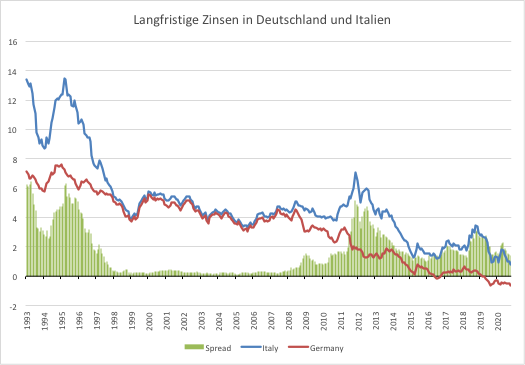
Italy may have to pay more than Germany, but the gap is small and at around 1%, Italian interest rates are also low in absolute terms. Under these circumstances and with a reasonable European debt rule for the future, Italy would not need the European bailout plan devised this summer, which is currently blocked by Hungary and Poland along with the Commission’s multiannual budget. 

However, individual Member State national budgets are of limited significance if it is not capital markets but the ECB that determines the terms of refinancing. This is exactly what the ECB does. The principle that the ECB must not finance government debt that was enshrined in the Maastricht Treaty – and still vehemently defended by Germany – is now little more than a fiction.

Harder ‘’to short’’ EMU member-states

We have reaped the full benefits of the European Monetary Union (EMU) because of the ECB’s pragmatic policy approach following the shock of the coronavirus pandemic. Had each individual country been forced to try to finance itself in capital markets, they would be easy picking for market speculators.

Speculators would have mercilessly targeted the national currencies of the countries, which, for whatever reason, would have been identified as candidates for devaluation. Such currencies would have been sold (“shorted”, in the parlance of the financial markets) and thus put under pressure to devalue.  

Such a purely speculative and unjustified devaluation can easily get out of hand to a point where the mass of citizens lose confidence in their own currency and flee to other currencies.

People then pay their taxes in their own currency and use it for daily shopping, but they no longer trust it for longer-term transactions. No government or central bank can want that. However, they cannot prevent it as easily as the ECB can prevent a rise in long-term interest rates. 

Foreign exchange reserves are always limited. Without them, states cannot intervene to buy their own currency to support its value, a fact that speculators are aware of and alert to.  Look at the current dilemma in Turkey where, in the middle of a severe recession, the central bank has raised interest rates significantly to protect its own currency from another drop against the euro and the dollar. In doing so, it is accepting the fact that the interest rate hike will cause serious damage to the Turkish economy. 

This proves the advantage of a large currency union. Nobody speculates against the euro or the dollar on a large scale, because every insider knows that the two most powerful central banks in the world can inflict huge losses on speculators in a concerted action within minutes.

In addition, speculation in foreign exchange always requires at least two currencies: a relatively stable one, in which one is in debt or has assets, and a less stable one, which one enters in order to collect high nominal interest rates and possibly exchange rate gains. 

If a large country like the United States or a large block of countries like the EMU with a single currency has a lower inflation rate and – relatively speaking – greater economic stability than most of the rest of the world, why would anyone want to speculate against their currency? For one thing, “devaluation” would require a more stable currency.

At the moment, the only candidate would be the Swiss Franc, which is precisely why the Swiss central bank systematically intervenes to weaken its own currency. The logic is the same as with competitiveness: without a reference currency that is seen as overvalued (not-competitive), there is nothing to exploit and therefore nothing to earn without actually making a productive investment in the real economy.

In view of the enormous advantages that a large and stable monetary union offers in such a crisis, it is all the more regrettable that Germany, with its nonsensical policy of persistent current account surpluses and its outdated economic policy doctrine is preventing the EMU from becoming a success story not just as a currency but also as an engine for European domestic development. 

Related News:

  • European Parliament look ahead — monetary policy, golden visas, deforestation
  • Eurozone citizens criticise ECB’s expansive monetary policy
  • Milena Hrdinkova: The Czechs will not sacrifice economic convergence for monetary integration
  • The detrimental effect of German economic thought on Europe’s monetary governance
Tags: BrusselsEurope-Featuremacro-economyNews
Next Post
Artificial intelligence (AI), machine and deep learning, neural networks and another modern technologies concepts.

FRA warns AI could jeopardise fundamental rights

Latest post

EU-elections-UK

EU elections: UK looks on from the “outside”

2 years ago
Galeries-Royales-Saint-Hubert

What Makes Galeries Royales Saint-Hubert an “Institution”?

2 years ago

Most Read

    Follow Brussels Morning
    Facebook Twitter Youtube Linkedin

    Browse Important News

    Belgium News
    Brussels News
    Culture and Society News
    Economy News
    EU Institutions News
    European Commission News
    European Council News
    European Parliament News
    Europe News
    Health And Fitness News
    Southeast Europe News
    Sustainable Perspective
    World News
    Diplomacy News
    US Elections News

    About Us

    Brussels Morning is a daily online newspaper based in Belgium. BM publishes unique and independent coverage on international and European affairs. With a Europe-wide perspective, BM covers policies and politics of the EU, significant Member State developments, and looks at the international agenda with a European perspective.

    More Info

    • About Us
    • Advertise With Us
    • Contact Us
    • Cookies Policy

    Join Our Newsletter

    Brussels Morning Newspaper – All Rights Reserved © 2024

    No Result
    View All Result
    • Home
    • About Us
    • Belgium News
      • Belgium Police News
      • Brussels News
    • Brussels Bubble
      • European Parliament News
      • European Commission News
      • European Council News
    • Wider Europe
      • Member States
    • World News
    • Business & Society
    • Europe With Transparency
    • Culture & Society
    • Policy Talks
      • Place de la Bourse
      • The Macro-Economist
      • Sustainable Perspective
      • Ambassador’s Corner
      • The American Angle
      • Southeast Europe
    • Print Magazine

    Brussels Morning Newspaper - All Rights Reserved © 2020

    We use cookies on our website to give you the most relevant experience by remembering your preferences and repeat visits. By clicking “Accept”, you consent to the use of ALL the cookies.
    Cookie settingsACCEPT
    Privacy & Cookies Policy

    Privacy Overview

    This website uses cookies to improve your experience while you navigate through the website. Out of these cookies, the cookies that are categorized as necessary are stored on your browser as they are essential for the working of basic functionalities of the website. We also use third-party cookies that help us analyze and understand how you use this website. These cookies will be stored in your browser only with your consent. You also have the option to opt-out of these cookies. But opting out of some of these cookies may have an effect on your browsing experience.
    Necessary
    Always Enabled
    Necessary cookies are absolutely essential for the website to function properly. This category only includes cookies that ensures basic functionalities and security features of the website. These cookies do not store any personal information.
    Non-necessary
    Any cookies that may not be particularly necessary for the website to function and is used specifically to collect user personal data via analytics, ads, other embedded contents are termed as non-necessary cookies. It is mandatory to procure user consent prior to running these cookies on your website.
    SAVE & ACCEPT